Gas Pool Heaters vs Electric Pool Heaters
From the high-rise suburbs of Brisbane; to the old-world streets of Toowoomba, to the sandy beaches of the Gold Coast, to the Sunshine Coast, to Ipswich, to the Northern Rivers— the warmer months are upon all of us in Queensland… and that means pool season!
After all, whether yours is an above-ground pool, or an in-ground pool, what better way to unwind and relax than spend the day lounging in the swimming pool, floating on your back, or doing laps, or simply just leaning against the sides and sipping on some lemonade? This is the definition of bliss… don’t you just wish it was pool season year-round?
We do, too! That’s why we recommend investing in the right resources for pool heating! Pool heating means you don’t have to give up swimming even during the winter months. But you do need to make sure you’re choosing the correct option when it comes to swimming pool heating—you need to go for the pool heating option that’s least costly, most efficient, and most reliable!
So, what’s the best way to heat up a pool?
Pool Heating Options
There are a bunch of pool heating options available out there, so let’s take a look at the facts and see which one works best for your swimming pool!
You have gas pool heaters, electric pool heaters, solar pool heaters, and pool heat pumps.
Which is the cheapest way to heat up your pool, while also being energy-efficient?
Let’s look at the two most common types of pool heaters—- gas pool heaters and electric pool heaters— and let’s decide which one works best for you.
How does a Gas Pool Heater Work?
A gas pool heater is the most common type of pool heater used. Gas pool heaters operate on natural gas or propane. The natural gas or propane is burned in a combustion chamber that contains copper coils. The water in the swimming pool is pumped into the heated copper coils, and the heat is transferred to the water which is then pumped back into the swimming pool. And voila! Your pool is ready for use, even in the winter!
Gas pool heaters remain the most popular type of swimming pool heaters, and newer models of gas pool heaters exhibit much higher efficiency as compared to the older models. But this does not necessarily mean that gas pool heaters are what will work best for you.
Pros and Cons of Gas Pool Heaters
Pros:
- Gas pool heaters are more popular, for a variety of reasons. They are the fastest pool heating method, heating the pool at 1 to 3 degrees per hour—which means you’ll only have to wait a few hours for the gas pool heater to heat up your pool completely!
- Gas pool heaters also have a much lower initial cost as compared to electric pool heaters or solar pool heaters.
- The newer models are more efficient as compared to the older models, and there is a lower cost of installation.
Despite all this, however, gas pool heaters do have their drawbacks as well.
Cons:
- Gas pool heaters are not exactly eco-friendly. Although the newer models don’t have as much of an environmental impact as the older models did, they do have a significant pollution factor.
- Gas pool heaters require either a gas line or a propane tank, and this needs to be positioned outdoors, in order to ensure maximum ventilation.
- Although gas pool heaters do have a relatively low initial cost, they do also have a high operational cost due to the amount of gas needed.
- They do also have a shorter lifespan as compared to solar pool heaters and pool heat pumps.
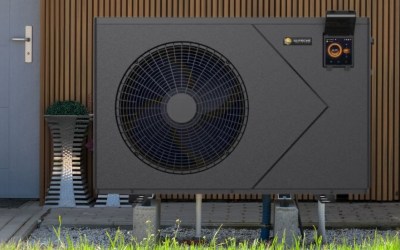
How does an Electric Pool Heater Work?
An electric pool heater does not operate on the same principle as a gas pool heater.
Instead of generating heat by itself, it sucks in the heat from the ambient air using a liquid refrigerant in an evaporator coil. This heat is then converted into a gas, which passes through a compressor, and subsequently, a condenser, where it is able to transfer heat into the water that’s running through the unit.
The heated water is then pumped back into the pool pump, and the heated gas turns back into liquid and returns to the evaporator coil so the process can be repeated.
If an explanation of the thermodynamics of your pool heater isn’t really your thing, we won’t judge you for skipping the above paragraph! All you need to know is that an electric pool heater is extremely efficient, and is capable of producing up to 10 times as much heat as other pool heaters!
Pros and Cons of Electric Pool Heaters
Pros:
- As we mentioned before, an electric pool heater is extremely efficient, with the capability of producing as much as 5-10 times the heat as other pool heaters.
- While gas pool heaters have a relatively short lifespan, electric pool heaters will last you a long time. Just make sure you perform routine maintenance checks, and your electric pool heater can last you at least a decade.
- Electric pool heaters are a much safer option than gas pool heaters, because there is no combustion involved. Unlike gas pool heaters, they can also be installed indoors— although they tend to be on the larger side, so making all that extra space in your house can be a bit of a challenge.
- If you’re environmentally conscious and you’re trying to reduce your carbon footprint, an electric pool heater is a much better option than a gas pool heater.
- Electric pool heaters are easily installed—although you should still call in a professional to make sure everything’s in place!
Cons:
- While electric pool heaters are much more efficient than gas pool heaters, they are also much slower, as they are only able to heat up to 3 to 5 degrees a day, in comparison to a gas pool heater’s 1 to 3 degrees per hour.
- The electric pool heater does not generate heat by itself; the degree to which it can heat up the pool is dependent on the ambient temperature. This means it won’t be able to suck in enough heat from the ambient air during the colder months—which means the winter season isn’t exactly going to be pool season.
- Electric pool heaters have a much higher initial cost than gas pool heaters. The units of electricity it consumes are also going to take a bit of a toll on your electricity bill, but refilling your gas pool heater doesn’t come too cheap either…
Which, again, begs the question, which is the right pool heating option for you?
Gas Pool Heaters or Electric Pool Heaters?
Now that you’ve taken a look at all the facts, we can only conclude that there isn’t really a right or wrong answer to this question. Both gas pool heaters and electric pool heaters have their merits and their flaws. Gas pool heaters may work better according to the requirements and living arrangements of some people, while electric pool heaters may prove the better choice for others based on their own living arrangements or set of requirements. Your choice needs to be based on what works for YOU.
Consider YOUR personal requirements and limitations, consider your priorities in terms of budget, efficiency, heat consistency, installation, maintenance, and repair—and make the choice that best suits YOU.
Here’s to a full year-round pool season!
Feel free to contact us if you would like more information on pool heating options and pricing!